
How long does Botox last? For most people, three to four months. The first change from Botox injections shows around day three to five, the full effect settles in at about two weeks, and fading starts between weeks eight and ten. Some people get two months, a few get six.
That range decides when to book for an event, when to rebook, and whether a result that faded early is something you can fix (usually it is).

Dr. Olivia, DNP, APRN, treating frown lines at Coastal. Learn more about Botox in Jacksonville.
Quick Answer: How Long Botox Lasts
How long does Botox last? Botox typically lasts three to four months. Botox injections start working in three to five days, peak at about two weeks, and the effects of Botox begin to fade around week eight to ten as the body clears the product. The detail that changes what you do: book your next visit before the result is fully gone, usually around week ten to twelve.
Key Points
- Forehead and frown line Botox treatments hold three to four months; a lip flip fades in eight to twelve weeks.
- Being treated with less than the full recommended amount is the most common fixable reason results fade early.
- Trial data shows the same duration of Botox in first-time and experienced patients; repeat treatments do not make it “build up.”
- No rubbing, lying down, or hard workouts on day one are the post-treatment care rules that matter; most other restrictions have little evidence.
- A visit in the first half of November peaks for Thanksgiving and still holds through the December holidays.
The Botox Timeline, Week by Week
How Botox works is simple: it is a purified form of botulinum toxin, made by the bacterium Clostridium botulinum, and it works by blocking nerve signals that tell a muscle to contract. The treated facial muscles relax, the skin over them stops creasing, and the dynamic wrinkles that show with facial expressions soften. Botox treatments take days to start and months to reverse.
Days 1 to 3: Nothing Visible Yet
Botox injections bind to nerve endings over the first day or two, but the muscle has not responded. You may feel mild heaviness or see a small bruise at an injection site. This is the window where aftercare matters: skip rubbing or pressing the treated area, stay upright for a few hours, and move the hard workout to tomorrow, so the product stays in the muscle it was placed in. The longer aftercare lists you see online have less behind them. A 5,000-patient aftercare study that limited instructions to a 10-minute precaution window saw no cases of eyelid drooping and minor side effects in about six percent of patients, mostly mild bruising and headache.
Days 3 to 14: Results Settle In
Botox results start to show around day three or four. The lines between the brows usually respond first, forehead lines a day or two later, and the full effect lands at roughly two weeks. That matches the typical onset window for wrinkle relaxers: a visible change in three to five days and the final picture by day ten to fourteen.
This is why Dr. Olivia, DNP, APRN, schedules a two-week check after Botox in Jacksonville. If one brow sits higher than the other, or a stubborn line has not fully relaxed, a small touch-up at that visit fixes it. Touching up earlier is guesswork, because the product has not finished working.
Weeks 2 to 8: Full Effect
Weeks two through eight are the plateau. Lines stay smooth at rest and with expression, and the treated muscles stay quiet whether you are concentrating, squinting into the Jacksonville sun, or laughing. If the dose and placement matched your facial anatomy, you still look like yourself, only rested: smoother skin, natural-looking results, a refreshed appearance rather than a frozen one. If you look frozen or your brows feel heavy, that is a placement or dose issue to raise at the two-week check, not something that improves with time.
Weeks 8 to 16: Gradual Wear-Off
Your body breaks the product down, the nerve endings recover, and the nerve signals that drive movement resume. Nothing is stuck in the muscle. The Botox effects fade in the order they arrived: a faint crinkle when you raise your brows, then full muscle movement over several weeks. In the main approval trial of Botox for frown lines, about eight in ten patients still had none-or-mild lines at day 30, about half at day 90, and one in four at day 120. That curve is why “three to four months” is the honest average and why the rebooking sweet spot sits at week ten to twelve.
| Stage | What you see | What to do |
|---|---|---|
| Days 1 to 3 | No visible change; maybe a small bruise | No rubbing, stay upright a few hours, skip the hard workout |
| Days 3 to 14 | Movement softens, lines smooth, full effect by about day 14 | Keep the two-week check for any touch-up |
| Weeks 2 to 8 | Smooth at rest and with expression | Daily SPF; nothing else to do |
| Weeks 8 to 16 | Small movements return, lines reappear slowly | Rebook around week 10 to 12, before results are gone |
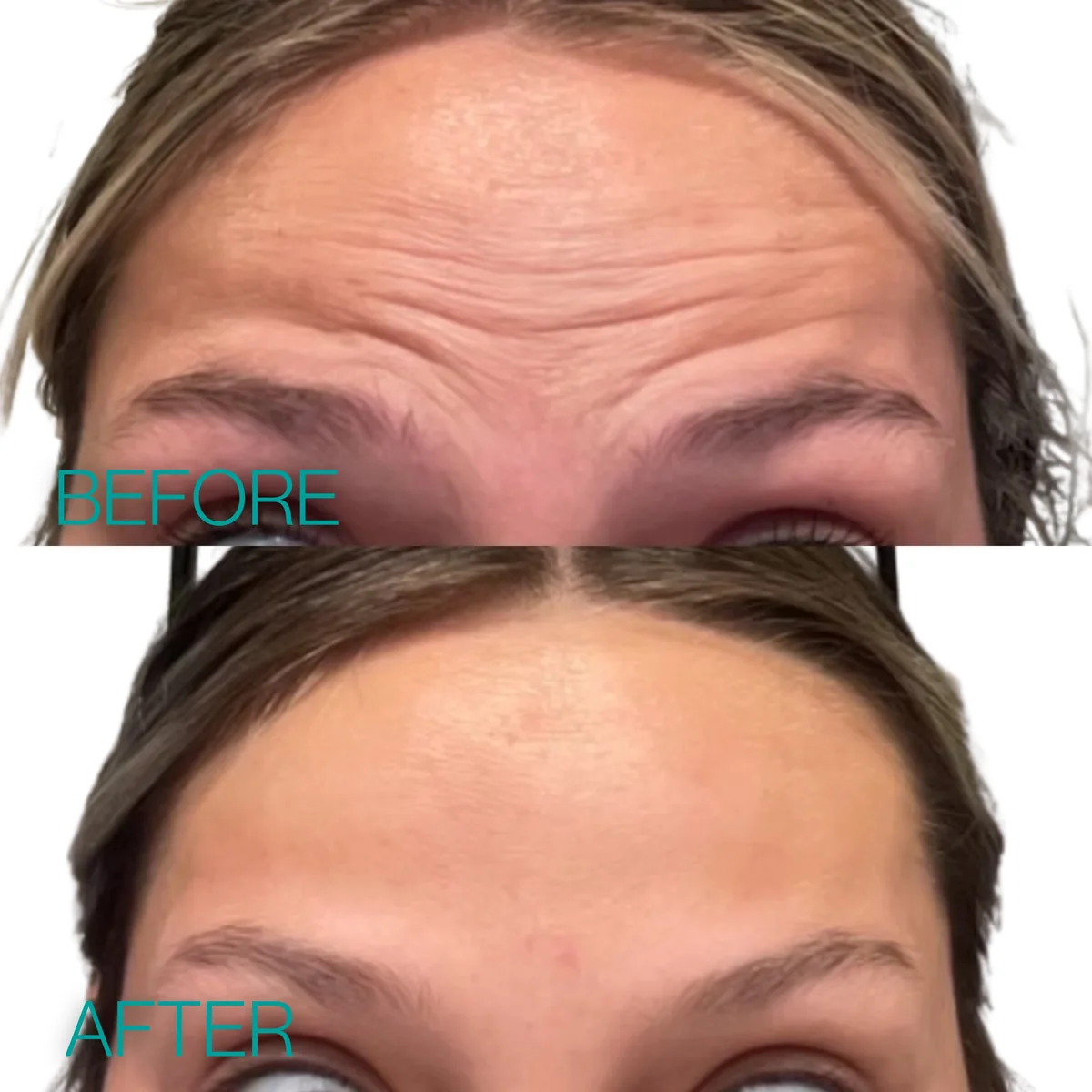
A Coastal patient's forehead lines before treatment and at the two-week peak. Results vary. See more forehead line results.
How Long Botox Lasts by Treatment Area
Botox longevity follows a consistent pattern for dynamic wrinkles: Botox duration depends on muscle mass and on how often the area treated moves. Your forehead muscle only fires when you raise your brows, so horizontal forehead lines usually get the full three to four months. The muscle ring around your mouth moves every time you talk, eat, or sip, which is why lip flip results are the shortest on the list. A Botox brow lift works on the same forehead and frown muscles, so it tracks the standard range.
Botox Cosmetic is FDA-approved for the lines between the brows, forehead lines, crow’s feet, and vertical neck bands; the brow lift, lip flip, bunny lines, and chin are common uses on the same principle, and other treatments such as jaw slimming, muscle spasms, and excessive sweating run on their own timelines. Against dermal fillers, the difference in Botox vs fillers longevity is large: most fillers hold six months to two years.
| Treatment area | Typical duration | Why it differs |
|---|---|---|
| Forehead lines | 3 to 4 months | Broad muscle, moderate movement |
| Frown lines (glabella) | 3 to 4 months, sometimes longer | Strong but small muscle group, and the best-studied area |
| Crow’s feet | 2 to 4 months | Thin muscle ring that fires with every smile and squint |
| Botox brow lift | 3 to 4 months | Depends on the balance between brow lifters and depressors |
| Lip flip | 8 to 12 weeks | Very small amount in a muscle that never rests |
| Nefertiti neck lift | 3 to 4 months | Broad neck muscle with moderate activity |
| Bunny lines and chin | 2 to 4 months | Small muscles with less constant movement |

Dr. Olivia mapping treatment areas in the mirror before placing anything. See the Botox treatment areas Coastal treats.
What Shortens Botox Results
Several factors influence how long Botox holds. If your Botox effects fade at six or eight weeks instead of twelve, one of these five is usually the reason, and the first three are the ones you and your injector can change.
First Treatments Often Fade Sooner
Many patients feel their first Botox treatments wore off faster than their second or third. Part of that is attention: a first-timer watches the mirror every morning and catches the earliest flicker of movement. Part of it is dosing: first visits are often treated cautiously while the injector learns how your muscles respond, and a lighter treatment fades earlier.
What it is not is the muscle “learning” to stay relaxed. In a large trial program that compared patients who had never had a wrinkle relaxer with patients who had, the prior-treatment analysis found the same duration in both groups, about 24 weeks for that product. A short first result was most likely a conservative dose, which is fixable at your next visit.
Strong, Expressive Muscles
Big, active facial muscles overpower a standard treatment faster than small, quiet ones. Muscle strength and muscle mass both count: men tend to have thicker brow and forehead muscles, so their results often sit at the short end of the range unless the treatment is adjusted. Very animated people, habitual squinters, and anyone who frowns at a screen all day put the same extra demand on the product. The fix is not to stop making faces. It is to tell your injector plainly how expressive you are, so the amount and placement match your muscle rather than the average patient’s.
Dose and Placement
Being treated with less than the full recommended amount for your anatomy is the single most common reason a result disappoints, and the easiest to correct. In a dose-response review of frown line trials, patients treated at the standard level held their result a median of about four months, those treated at higher levels closer to six, with no increase in side effects, and those treated below the standard level faded sooner than either. “Baby Botox” has its place for a very light look, but it is a trade: softer effect, shorter life.
Placement matters as much. Product placed too shallow, in the wrong muscle belly, or spread too widely relaxes less of the muscle that makes the line, so muscle movement returns earlier.
Metabolism, Exercise, and Sun
Lifestyle factors matter less than dose, but they are real. Patients who metabolize quickly, and people who train hard several times a week, often report shorter results. The evidence is thinner than for dose, so treat these as reasons your range might sit at the short end. Skip the intense workout on treatment day, then train as usual.
Sun works differently. Excessive sun exposure does not speed up how fast the product clears, but it damages collagen in the skin above the muscle, so lines look more visible even while the muscle is relaxed. In Jacksonville, avoiding excessive sun exposure is a year-round job, and daily broad-spectrum sunscreen keeps skin health and skin elasticity up so the result reads as smooth for the whole cycle.
Injector Technique
Two injectors can use the same amount of the same product on the same face and get Botox outcomes that differ by weeks. Injection technique covers depth, the point of entry, how many injection sites the amount is split across, and whether the injector mapped your muscle while you were frowning and raising, not just at rest. Treating the pattern you make, rather than the textbook grid, relaxes more of the right muscle with the same amount.
Proper technique also decides whether the result looks natural. Dr. Olivia, DNP, APRN, assesses each patient’s muscle movement before marking any injection points, and her pharmacology background shapes how she thinks about dose and spread. Ask any injector how they decide placement; a clear answer is a good sign.

Every Botox plan at Coastal starts with a movement assessment in the treatment room. Schedule a Botox consultation.
How to Make Botox Last Longer
No cream or balanced diet makes the product work longer. What you can do is remove the avoidable reasons for early fading.
- Follow the first-day rules from the timeline above. Before a first visit, the checklist in how to prepare for Botox covers what to pause beforehand to minimize bruising.
- Keep the two-week check, so asymmetry or an under-treated spot is corrected early.
- Stay on a consistent schedule. Regular treatments around week ten to twelve keep the result steady.
- Protect the skin over the muscle. Daily SPF plus a retinoid-based routine supports healthy skin between visits; Danielle Hancock, Licensed Aesthetician at Coastal, builds skincare plans around injectable schedules.
- Avoid treating too little. If your last result faded at six weeks, ask whether the treatment was conservative; matching the amount to your muscle is the change most likely to add weeks.
- Be skeptical of supplement claims. Zinc has a basis (the product works through a zinc-dependent step), but a 2026 supplement review found the trial evidence for zinc inconsistent and the evidence for everything else speculative.

Reviewing aftercare and a treatment schedule at Coastal. Book a free consultation to plan yours.
How Often Should You Get Botox Treatments?
For most patients, maintenance treatments fall every three to four months, or three or four Botox treatments a year. The floor is firm: the Botox Cosmetic prescribing information states that Botox injections more often than every three months have not been evaluated, so a reputable injector will not give frequent injections to the same area inside that window.
Above the floor, the right interval is personal, because the duration of Botox varies from one face to the next. Some patients come in right at three months so movement never shows; others stretch to five or six. In a real-world cohort followed for 15 years, the typical gap was about six months. Either is fine. The habit that keeps Botox results consistent is booking the next visit before you leave the current one.

A maintenance visit at Coastal. Book a follow-up before your results are fully gone.
Does Botox Last Longer the More You Get It?
The product itself does not. Trial data comparing first-time and experienced patients shows the same duration in both groups, and a 15-year real-world study of patients who had repeated injections for years found no sign of the effects of Botox wearing off faster or lasting longer over 1,098 treatment cycles. Nothing accumulates in the muscle.
What does change is your baseline. After several cycles of a muscle spending most of its time relaxed, the line it used to carve is shallower, so when movement returns the wrinkle is fainter than before you started. That is Dr. Olivia’s clinical observation at Coastal: patients who keep consistent treatments often say the result “feels” like it holds longer, and she attributes that to softer lines at the starting point, not to the product lasting longer.
Botox vs Dysport vs Letybo: Does One Last Longer?
All three wrinkle relaxers offered at Coastal are botulinum toxin type A, and for most patients the effects of Botox, Dysport, and Letybo hold for the same three to four months. The differences are onset and spread. Dysport in Jacksonville tends to show within a day or two and diffuses a little more widely, which suits the forehead. Letybo in Jacksonville is the newest of the three in the United States and is approved for the lines between the brows; Letybo vs Botox covers how the two compare in practice.
One product does last longer. Daxxify, a newer formulation, held frown line results for a median of 24 weeks in its phase 3 trials. Coastal does not currently offer it, and Dr. Olivia will say so if your goals would be better served by it.
| Product | Onset | Peak | Typical duration | Offered at Coastal |
|---|---|---|---|---|
| Botox | 3 to 5 days | About 2 weeks | 3 to 4 months | Yes |
| Dysport | 1 to 3 days | About 2 weeks | 3 to 4 months, up to 5 for some | Yes |
| Letybo | 2 to 3 days | 7 to 10 days | 3 to 4 months | Yes |
Timing Botox for the Holidays in Jacksonville
For any event, book Botox injections two to three weeks ahead so the result has fully settled, and four weeks ahead if it is your first time, which leaves room for a touch-up at the two-week check. For the winter holidays, one visit in the first half of November does double duty: it peaks for Thanksgiving on November 26, and the Botox effects are still in their full window through Christmas and New Year’s Eve, six to eight weeks later. A mid-October visit is ten weeks old on December 25 and visibly softening. For Christmas only, book by December 10.

Dr. Olivia, DNP, APRN, plans every Botox schedule in person. Schedule a consultation at Coastal.
Your Next Step: Plan Your Botox Schedule With Coastal
You now know the answer to “how long does Botox last,” the Botox timeline, and the five factors that shorten Botox longevity. The rest depends on your facial anatomy, your treatment area, and which facial expressions you want to keep, and Dr. Olivia, DNP, APRN, turns that into a treatment plan at a free consultation. Book a consultation at Coastal Health & Medical Spa in Jacksonville, or read more about the Coastal team first.
Frequently Asked Questions
When does Botox start to wear off?
Most people notice the effects of Botox fading around weeks eight to ten: a faint crinkle when raising the brows or a shallow line when concentrating. The fade is gradual, with full movement back over several weeks. Booking your next visit around week ten to twelve keeps lines from fully re-forming.
Does Botox wear off quickly the first time?
It often feels that way, for two reasons that have nothing to do with the product. First visits are frequently dosed conservatively while the injector learns your muscles, and a lighter treatment fades earlier. First-timers also watch the mirror closely. Trial data shows the same duration in first-time and experienced patients, so if your first result was short, ask about the dose rather than waiting for the product to “build up.”
What happens to Botox when it wears off?
When Botox injections wear off, your body has broken the product down and the treated nerve endings have recovered, so muscle movement returns to exactly what it was before treatment. Nothing stays trapped in the muscle. If you have been treated consistently, your baseline often looks better than before you started, because the line has spent months without being creased.
Why is my Botox only lasting 6 weeks?
The most likely reason is that the amount was too low for the muscle strength and size of the targeted muscles, which is common on a cautious first visit and easy to correct. Strong, expressive muscles, a fast metabolism, heavy training, and product that did not reach the whole muscle can also push you to the short end. Bring the timeline to your injector and ask what to adjust.
What helps Botox last longer?
Getting the full amount your muscles need, keeping the two-week check so any gaps are corrected, and rebooking before the result is gone. On day one, avoid rubbing the area, stay upright for a few hours, and skip hard exercise. Daily sunscreen and a good skincare routine keep the skin over the muscle smooth. Zinc and other supplements have inconsistent evidence, so do not count on them.
What does Botox look like after 10 years?
Long-term patients on regular treatments usually have softer forehead and frown lines at rest, and a more youthful appearance, than they would have had otherwise, because the muscles that carve those lines have spent years mostly relaxed. A real-world study following patients for 15 years found no loss of effect and no safety problems with continued treatment. If you stop, movement returns to normal over a few months.
