
Menopause weight gain happens because falling estrogen shifts fat storage to your abdomen, age-related muscle decline lowers the calories you burn at rest, and broken sleep pushes appetite up. What helps most is protein at every meal, strength training twice a week, protecting your sleep, and a hormone evaluation when symptoms point that way.
The frustrating part? Nothing about your habits changed. You eat the way you ate at 38, you walk the same loop, and the waistband that fit last spring now digs in by lunch. That’s physiology, and it has a pattern you can work with.
The scale often undersells it. Many women in the menopause transition gain weight as fat and lose muscle at the same time, so clothes fit differently while the number barely moves. That’s why the fix has to be specific, and why more cardio on its own rarely works.

Dr. Olivia, DNP, APRN, with a patient at Coastal Health & Medical Spa. Hormone therapy in Jacksonville starts with labs and a symptom history.
Quick Answer: Why Menopause Causes Weight Gain and What Helps
Estrogen levels fall through the menopause transition, your body stores fat deep in the abdomen instead of on your hips and thighs, and the muscle you lose with age lowers your resting calorie burn. Work the levers you control: more protein, two strength sessions a week, better sleep, less alcohol, and hormone and metabolic labs when symptoms stack up.
Key Points
- Fat gain roughly doubles and lean mass starts falling at the start of the transition, then both level off about two years after your final period.
- Waist size can grow while scale weight barely moves, because fat is replacing muscle.
- Muscle mass drops 3 to 8 percent per decade after 30, which is why calorie needs fall even when appetite doesn’t.
- HRT is prescribed for menopausal symptoms; in studies it may limit abdominal fat gain, though the effect is modest.
- Rapid gain, thyroid symptoms, or bleeding changes mean labs first, before another diet.
When Menopause Weight Gain Starts and When It Stops
For most women, weight gain during menopause starts earlier, in perimenopause, the stretch of irregular cycles that typically starts in the mid-forties, a few years before the final period. Weight tends to climb steadily through the forties and fifties, and the hormonal changes of the menopause transition change what that weight is made of more than how fast it arrives.
In the SWAN body-composition study, which followed women through the transition with body scans, the rate of fat gain doubled when the transition began and lean mass started to decline. Both trends kept going until about two years after the final menstrual period, then flattened out.
So the window is real but finite. The fat you add in that stretch tends to stay unless you change something, but the acceleration itself ends, which makes holding a healthy weight through the transition more doable than it feels.
Why Menopause Weight Gain Happens
Four things change at once, and they feed each other.
Falling Estrogen Moves Fat to Your Middle
Before menopause, estrogen steers fat storage toward your hips and thighs. As estrogen levels drop, that signal fades and your body redistributes fat: less subcutaneous fat under the skin on your hips and thighs, more visceral fat, the deep kind that packs around the internal organs inside your abdomen. Menopause Society guidance on midlife weight puts it plainly: the aging process is the main driver of the weight itself, but menopause redistributes it, and the abdomen is where it goes.
This shift in fat distribution is why waist measurements change before the scale does. You can weigh what you weighed three years ago and need a different pant size, because the same pounds now sit in a different place. It’s also why menopause belly fat responds poorly to crunches. The fat sits behind the abdominal muscles, where no amount of core work reaches it.

Same scale weight, different fat distribution. The waist grows before the number moves.
Muscle Loss Slows Your Metabolism
Muscle is the most expensive tissue you own. It burns more calories at rest than fat does, and you have less of it every year. A review of muscle loss with aging puts the loss of muscle mass at roughly 3 to 8 percent per decade after age 30, with the rate climbing again after 60. Menopause stacks on top of that, since the SWAN data above show lean mass falling faster once the transition begins.
The result is a slower metabolism: you burn fewer calories at rest. Eat exactly what you ate at 35 and you’ll slowly gain, with nothing on your plate having changed. That’s the math behind “my metabolism slowed down,” and it’s the one cause on this list you can partly reverse.
Sleep, Hot Flashes, and Cortisol
Night sweats and hot flashes fragment sleep, and short sleep changes what you want to eat. In a study of sleep and appetite hormones, people sleeping about five hours had roughly 15 percent lower leptin, the hormone that signals fullness, and roughly 15 percent higher ghrelin, the hormone that drives hunger, than people sleeping eight. That’s a measurable push toward more food on less rest, independent of body weight. Hot flashes also wake many women two or three times a night, and each waking adds to the next day’s hunger.
Poor sleep also tends to raise cortisol, the stress hormone, and sustained cortisol favors fat storage around the midsection. Add a stressful decade (aging parents, teenagers, a career peak) and the loop closes: less sleep, more hunger, more belly fat, worse sleep.
Insulin Resistance and Cravings
Visceral fat cells behave differently from the subcutaneous fat cells under your skin. They release fatty acids and inflammatory signals into the bloodstream, and over time your cells respond less to insulin, the hormone that moves sugar out of your blood. That’s insulin resistance. Your pancreas compensates by making more insulin, and high insulin tells the body to store energy.
You feel it as blood sugar swings: a crash two hours after a carb-heavy lunch, afternoon cravings for something sweet, and hunger that returns faster than it used to. Each swing invites another snack, which adds more visceral fat, which worsens the resistance. Protein and fiber at each meal flatten those swings, and lifting makes muscle more responsive to insulin.
| Cause | What You Notice | What Helps Most |
|---|---|---|
| Falling estrogen levels | Thicker waist at the same weight; a menopause belly that crunches don’t touch | Hormone evaluation; protein and strength work to protect muscle |
| Muscle decline with age | Same intake, slow gain; weaker lifts and grip | Strength training twice a week; about 1.2 g of protein per kg daily |
| Broken sleep and cortisol | Night waking, afternoon cravings, storage around the middle | Treat hot flashes; fixed wake time; no alcohol near bedtime |
| Insulin resistance | Crashes after carb-heavy meals, hunger that comes back fast | Lean protein and fiber first at each meal; metabolic labs |
Perimenopause Weight Gain Starts Earlier Than You Think
Many women gain weight in perimenopause and are caught off guard because periods are still arriving, even as the menstrual cycle gets irregular. Estrogen doesn’t fall in a straight line during this stage; it swings, and sleep and mood often get disrupted years before the classic symptoms show up. The body-composition shift begins here too. In the SWAN cohort, the acceleration in fat gain started at the onset of the transition, well before the final period.
So if you’re 44, still cycling, and your waist has moved two inches, that’s consistent with perimenopause rather than evidence that you’ve let something slip. The full list of perimenopause symptoms runs from irregular cycles to joint aches, and weight that settles around the middle belongs on it. The earlier you treat this as physiology, the more muscle you keep.
Why Menopause Belly Fat Matters for Your Health
Menopause belly fat is mostly visceral fat, the kind that does the most damage. An NIH summary of weight-related health risks notes that the risk from extra weight rises especially when the fat sits around your waist, and it ties that pattern to type 2 diabetes, high blood pressure, heart disease and other cardiovascular disease, stroke, fatty liver, sleep apnea, metabolic syndrome, and certain cancers.
The practical takeaway: for metabolic health, a waist measurement tells you more than the scale does at this stage. Track it monthly. If it keeps rising while your weight holds, you’re trading muscle for visceral fat, and that’s the point to get labs drawn even when the number on the scale looks fine.
What Actually Helps With Menopause Weight Gain
In rough order of payoff. None of these is a diet; they’re lifestyle changes that work with the hormonal changes instead of against them.
Protein at Every Meal
Protein does two jobs here. It’s the raw material for keeping muscle, and it’s the most filling macronutrient per calorie, which matters when ghrelin is running high. A useful target is about 1.2 grams of protein per kilogram of body weight a day, which for a 150-pound woman works out to roughly 80 grams. Most women eat a third of that at dinner and almost none at breakfast.
Spread it out instead: eggs or Greek yogurt in the morning, then a palm-sized portion of lean protein (fish, chicken, beans, or tofu) at lunch and dinner. Pair each meal with fiber (vegetables, beans, berries, whole grains) and the blood sugar swings from the insulin section get flatter without counting anything.
Strength Training Twice a Week
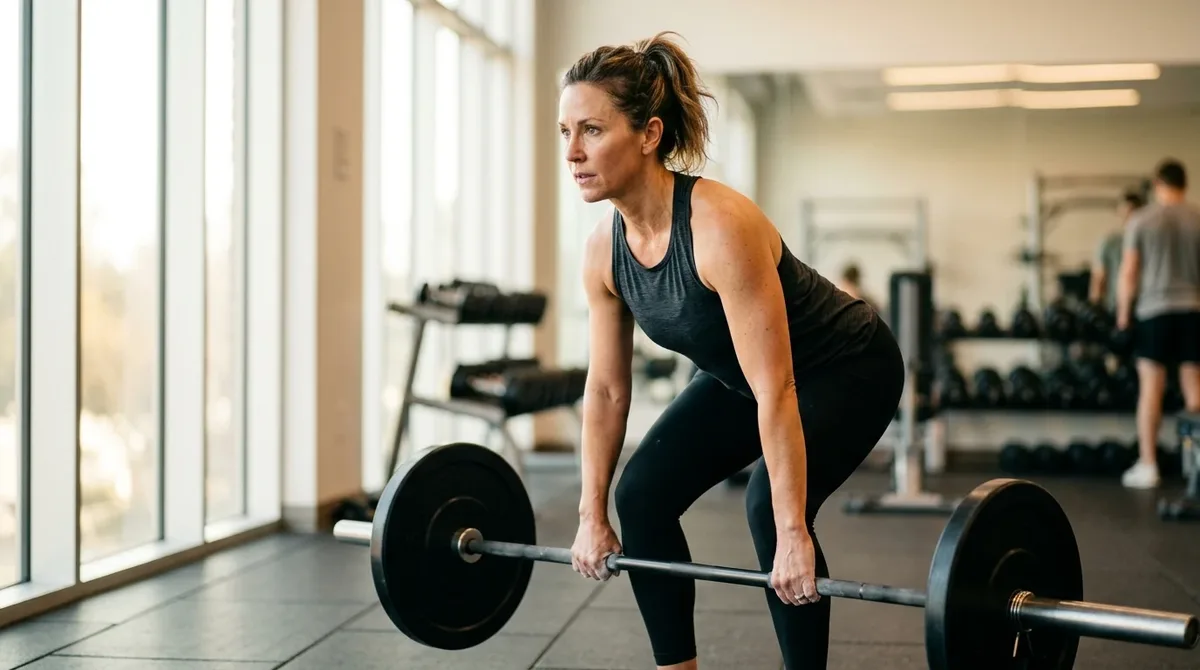
If you change one thing in your exercise routine, make it this one. Cardio burns calories while you do it; strength training rebuilds the tissue that burns calories all day, and it’s the only lever that directly counters the muscle decline driving the slowdown. Two sessions a week is the standard recommendation, and it’s enough to make progress.
Focus on compound movements that load several muscle groups at once: squats, deadlifts, rows, presses, and loaded carries. Use a weight that makes the last two or three reps hard, and add a little when it stops being hard. Walking, brisk walking, and other aerobic exercise still count for heart health and stress. It won’t rebuild muscle, though, and rebuilding muscle is the assignment. Muscle that gets used also takes up glucose more readily, which helps on the insulin side.
Sleep and Stress Before Cardio
Adding a fourth spin class to a body that sleeps five hours a night rarely works, because the hunger signals from short sleep outrun the extra burn. Poor sleep is the first thing to fix. If hot flashes or night sweats are waking you, that’s a treatable symptom, and treating it is often the one change that makes the rest of this list stick.
Beyond that, the basics hold: a fixed wake time seven days a week, a cool bedroom, no alcohol within three hours of bed, and screens off before you lie down. For stress, pick something you’ll do, whether that’s a ten-minute walk after dinner or a weekly class. Lower cortisol means less of the midsection storage signal, and better sleep means fewer cravings to fight the next day.
Alcohol, Portions, and the Calorie Math
Here’s the uncomfortable arithmetic. As muscle mass drops, so do your calorie needs, and appetite doesn’t automatically drop with them. Eating the way you did at 35 now produces a small daily surplus, and a small daily surplus is a pant size in a couple of years.
Alcohol is the easiest place to find those calories: a glass of wine most nights adds up fast, it worsens sleep, and it lowers your resolve around the cheese board. Portions are the second place. You don’t need a smaller plate of everything; a balanced diet that shifts the ratio so protein and vegetables take more of it and starches take less works better. If you’ve already done all of this and the scale has stalled for weeks, the pattern is a weight loss plateau and needs a different fix than eating less.
Does HRT Help With Weight Loss?
Honestly? Indirectly, and never as a weight-loss drug. Menopausal hormone therapy is prescribed for menopause symptoms, and the 2022 hormone therapy position statement names hot flashes, night sweats, and genitourinary symptoms as the reasons to treat, along with bone protection. Weight loss isn’t on the list.
What the research does show is a body-composition effect. A pooled analysis of 107 trials found that women on hormone therapy had about 7 percent less abdominal fat, a 13 percent improvement in a standard measure of insulin sensitivity, and fewer new diabetes diagnoses than women off it. The effect is modest, and it applies to where fat goes rather than how much you weigh.
The bigger win is indirect: sleep improves when the sweating stops, energy returns, and lifting and cooking become things you do again. At Coastal, hormone therapy in Jacksonville starts with labs and a symptom history, and Dr. Olivia, DNP, APRN, prescribes it for symptoms. Any change in body composition is a possible side benefit, never the goal.
What to Expect in the First Three Months on HRT
The first weeks can be unglamorous. Some women notice bloating, water retention, or breast tenderness as the body adjusts, and the scale may tick up a little fluid weight before it settles. That typically eases within two or three months as treatment is adjusted, and sleep usually improves well before anything changes at your waist.
Results vary, and treatment is individualized with periodic reevaluation. The benefit-risk picture is most favorable for women under 60 or within ten years of menopause onset, which is why when to start HRT deserves its own conversation.
Medical Weight Loss Options When Lifestyle Isn’t Enough
Some women do everything above and still don’t move, usually because blood sugar problems, a thyroid problem, or a long-standing weight set point is working against them. That’s where a supervised weight management program earns its place. At Coastal, medical weight loss in Jacksonville starts with hormone and metabolic labs, including thyroid and sex hormones, so the plan is built on what your blood work shows rather than a guess.
Depending on results, the program may include prescription weight-loss medication alongside nutrition and strength coaching aimed at a healthy weight you can hold. These medications work on appetite and blood sugar signaling, which maps onto the insulin and craving problem above. They’re prescribed only when clinical criteria are met, they work with your lifestyle habits rather than instead of them, and Dr. Olivia, DNP, APRN, monitors labs and progress throughout. Weight management at this stage is a long-term plan, not a quick fix.

The Coastal team at the women’s wellness clinic in Jacksonville.
When to Get Your Hormones Checked
Slow gain around the middle through your forties and fifties fits the menopause pattern. A few things don’t, and they mean labs before anything else. Rapid gain over weeks rather than years. Feeling cold, constipated, or losing hair, which point to thyroid. Any change in bleeding: heavier, longer, or bleeding after a year without periods. New fatigue that sleep doesn’t fix. Unexplained weight loss, which is never a menopause symptom. Each of these needs a provider, and some need one promptly.
For everyone else, a hormone panel plus thyroid and metabolic labs is the first step when symptoms stack up, because it tells you whether you’re treating menopause, a thyroid problem, a blood sugar problem, or a mix. At Coastal’s women’s wellness clinic in Jacksonville, that evaluation is the starting point.

A hormone panel is step one. Hormone testing in Jacksonville at Coastal typically includes thyroid and metabolic labs.
Your Next Step: A Hormone and Weight Evaluation in Jacksonville

Book a free consultation with Dr. Olivia, DNP, APRN, at Coastal.
Menopause weight gain has a mechanism, and mechanisms can be worked on. Gaining around the middle, sleeping badly, and wondering whether HRT fits is the picture this evaluation was built for. Book a hormone and weight evaluation with Dr. Olivia, DNP, APRN, at Coastal in Jacksonville, read about the Coastal team, and get your answer from blood work rather than a guess.
Frequently Asked Questions
How do I get rid of menopausal weight gain?
Start with the levers that address the cause: protein at every meal, strength training twice a week, seven or more hours of sleep, and less alcohol. Those protect muscle, reduce belly fat over time, and flatten the hunger signals driving the gain. If your waist hasn’t moved in three months, get hormone, thyroid, and metabolic labs so the next step is based on what’s wrong.
Can hormone replacement therapy help with weight loss?
Indirectly. Hormone therapy is prescribed for menopausal symptoms such as hot flashes and sleep disruption; weight loss isn’t an approved reason to take it. In pooled trials, women on therapy had modestly less abdominal fat and better insulin sensitivity than women off it. The practical benefit is better sleep and more energy, which make exercise easier to keep up. Results vary.
Does HRT make you put on weight or lose weight?
Neither, for most women. HRT isn’t a weight-loss treatment, and the research doesn’t support the idea that it causes fat gain. Some women notice fluid retention or bloating in the first weeks, which usually eases as treatment is adjusted. Longer term, studies suggest therapy may limit the shift of fat toward the abdomen, so clothes can fit differently while the scale stays put.
Is it easier to lose weight after menopause?
Usually it’s harder, for two reasons. You have less muscle than at 40, so your resting calorie burn is lower, and more of your body fat is visceral, which is tied to blood sugar swings and stronger cravings. The upside: the acceleration in fat gain ends a couple of years after your final period. With adequate protein and regular resistance training, postmenopausal women can lose fat.
What do doctors prescribe for menopause weight gain?
There’s no prescription specifically for it. Providers treat the pieces: hormone therapy for hot flashes, night sweats, and sleep disruption when symptoms warrant it; thyroid treatment if labs show a thyroid problem; and, for women who meet clinical criteria, prescription weight-loss medication that works on appetite and blood sugar signaling. None of it replaces the lifestyle changes: protein, lifting, and sleep.
Is it true that perimenopause can make it difficult to lose weight?
Yes. Perimenopause is when the body-composition shift begins: fat gain accelerates and lean mass starts to decline before your final period. Swinging hormone levels also disrupt sleep, which raises hunger hormones. The calorie cut that worked at 35 often stalls now because muscle is lower and cravings are higher. Protein and resistance training matter most in this window.
Why am I not losing weight during menopause?
The usual reasons, in order: your calorie needs dropped with your muscle and your intake didn’t; short sleep from night-time waking is pushing hunger up; cardio without strength work is costing you muscle; and high insulin is keeping stored fat stored. Less often, a thyroid problem is the cause. After six consistent weeks with no change in weight or waist, get labs rather than cutting further.
Is rapid weight gain a common symptom of menopause?
No. Menopausal weight gain is gradual, a steady climb through the forties and fifties with the fat settling around the middle. Gaining noticeably over a few weeks points to something else: a thyroid problem, a new medication, fluid retention, or another medical issue. Rapid gain, especially with swelling, fatigue, or a change in bleeding, needs a provider visit and blood work.
