A HydraFacial deeply cleanses, exfoliates, extracts and hydrates your skin in one visit with no downtime. The HydraFacial benefits are real if you want an instant glow, clearer pores and better hydration. It is not the tool for deep wrinkles, scars or stubborn pigment. Most people rebook every 4 to 6 weeks to keep the results going.
The question we hear most isn’t “does it work.” It’s “do I really need this every month?” The honest answer depends on your skin type, what you’re treating and what your skincare routine does between visits. This guide covers what a HydraFacial treatment does, when it’s worth it, how to space visits and how to protect the results.

The same-day glow after a HydraFacial at Coastal. See the tiers for a HydraFacial in Jacksonville.
Quick Answer: What a HydraFacial Does
A HydraFacial treatment uses a spiral vortex tip that pushes hydrating serums into the skin while it vacuums out oil, dead skin cells and debris. It is deep cleansing, gentle exfoliation and hydration in one pass, and nothing is squeezed by hand. One practical detail that trips people up: book 3 to 7 days before an event, not the day before, so any mild redness fades and the glow peaks on time.
Key Points
- A visit runs about 30 to 60 minutes and you can go back to work afterward.
- The glow peaks at 24 to 48 hours and holds about a week; texture and pore benefits last a few weeks.
- Small trials show thicker, better-hydrated skin and fewer fine lines after a series, but the evidence is small and short-term.
- It does not remodel collagen like microneedling or laser treatments, so deep wrinkles and scars need something else.
- Maintenance is every 4 to 6 weeks; acne or congestion may start on a closer schedule your provider sets.
- Aftercare means no makeup the rest of the day, no heat for 24 hours and no actives for 48 to 72 hours.
What a HydraFacial Is and How It Works
A HydraFacial is a hydradermabrasion treatment. That word just means exfoliation done with fluid and light suction instead of crystals or a scrub. The handpiece uses a spiral-shaped tip that creates a small vortex of water and serum against your skin. As the tip moves, it is removing dead skin cells, pulling oil and debris into a collection cup, and leaving hydrating serums behind in the same pass. The manufacturer’s four-step description lists cleanse, exfoliate, extract and hydrate, and that is the order you’ll feel it in.
A full visit runs about 30 to 60 minutes depending on the tier. There’s no downtime, which is the main difference from chemical peels and laser treatments that trade a few days of flaking or redness for deeper results. If you know how to prepare for a HydraFacial, the visit is simpler still: pause retinoids and exfoliating acids for a couple of days and arrive with clean skin.

Dr. Olivia, DNP, APRN, with the vortex handpiece during the HydraFacial treatment at Coastal.
| Step | What Happens | What You Feel |
|---|---|---|
| Cleanse | Deep cleansing: the vortex tip lifts surface oil, makeup residue and dead skin | A cool, gliding sensation |
| Exfoliate | The exfoliation process: a mild glycolic and salicylic acid peel loosens dead skin cells without flaking | Light tingling, no sting |
| Extract | Painless suction pulls blackheads and congestion out of pores into a collection cup | A gentle pulling, far less pressure than manual extractions |
| Hydrate | Antioxidant, peptide and hyaluronic acid serums are infused into freshly treated skin | Cool, soothing moisture |
HydraFacial Benefits You Can Actually Expect
You’ll walk out with cleaner, plumper, more hydrated skin. That part is hard to argue with. The bigger question is how far the HydraFacial benefits go beyond the surface and how long they stick around. The honest answer is that this treatment is excellent at hydration, mild congestion and glowing skin, reasonably good at skin texture and fine lines over a series, and a sensible monthly habit for overall skin health. The studies behind those claims are small, so treat the figures below as encouraging, not settled.
Immediate Hydration and Glow
The hydrate step infuses hyaluronic acid and antioxidants into skin that has just been exfoliated, so the serums reach skin that would normally be sitting under a layer of dead cells. That is why the glow shows up the same day and not after a week of waiting. Skin looks more radiant and even, feels smoother to the touch and stays hydrated better than it did that morning. These immediate benefits are the ones people photograph.
Peak results typically land at 24 to 48 hours, once any mild pinkness settles. The visible glow holds for roughly 5 to 7 days before it softens as your skin returns to its normal cycle. For dull skin or dry skin from Florida air conditioning and sun exposure, this is the benefit most people notice first and the reason they come back.
Gentle Extractions and Clearer Pores
Manual extractions hurt, and squeezing often leaves redness or small marks for a day. The HydraFacial tip pulls congestion out of clogged pores with suction instead of pressure, which is why most people describe it as a light tug rather than pain. Blackheads, sebaceous filaments on the nose and the gritty buildup on the chin respond well. You’ll see what came out in the collection cup afterward, which is oddly satisfying.
Enlarged pores don’t shrink permanently, but pores that are emptied and hydrated look smaller and more refined for a few weeks, which reads as smoother, clearer skin. Regular treatments keep them that way. For oily skin or combination skin, this is often the main reason to get a HydraFacial rather than a traditional facial.
Smoother Texture and Softer Fine Lines
A small 2008 hydradermabrasion trial followed 20 women aged 34 to 56 through six treatments spaced 7 to 10 days apart. Biopsies showed a thicker epidermis, more antioxidant in the skin and a denser upper dermis, and the women had fewer fine lines, smaller pores and less pigmentation afterward, with no complications. The same serum applied by hand without the suction step changed nothing.
Twenty participants is a small trial, and it measured a short series rather than years of monthly treatments. What it does show is that the exfoliation plus suction plus serum combination does something a serum alone can’t. In practice, that means improved skin texture, less uneven texture on the cheeks and softer early signs of aging after a few visits, not a lifted face.
Help for Acne-Prone and Oily Skin
A 2022 acne treatment series enrolled 20 adults with mild to moderate acne for six HydraFacial clarifying treatments, one every two weeks. The share rated clear or almost clear by the investigators rose from 20 percent to 65 percent, and from 5 percent to 55 percent by the patients themselves. Treatments were generally well tolerated.
Two caveats: the study was small, open-label and partly company-sponsored, and the treatments included blue LED light, so the results reflect the series as a whole. It fits the acne skin-care guidance that favors gentle cleansing over scrubbing, which is exactly what suction-based extraction does. HydraFacial won’t clear cystic acne on its own, but for oily skin with congestion and surface breakouts, a short series your provider sets can help.
Safe for Most Skin Types and Tones
HydraFacial is used on all skin types and tones, including sensitive skin, because there is no heat and no deep peel to trigger post-inflammatory pigment. A 2024 skin-imaging study scanned eight volunteers with Fitzpatrick skin types II through V before treatment, right after, and two weeks later. It showed a smoother, more even outer skin layer and no visible change to dermal collagen at two weeks.
That last finding matters for honesty: the benefit sits in the epidermis, the layer you can see and feel. The evidence base is small and short-term across all three studies above, so nobody can promise a specific result for your skin. What the data supports is a low-risk treatment that works across skin tones, with the booster choice and suction level adjusted for sensitive skin.
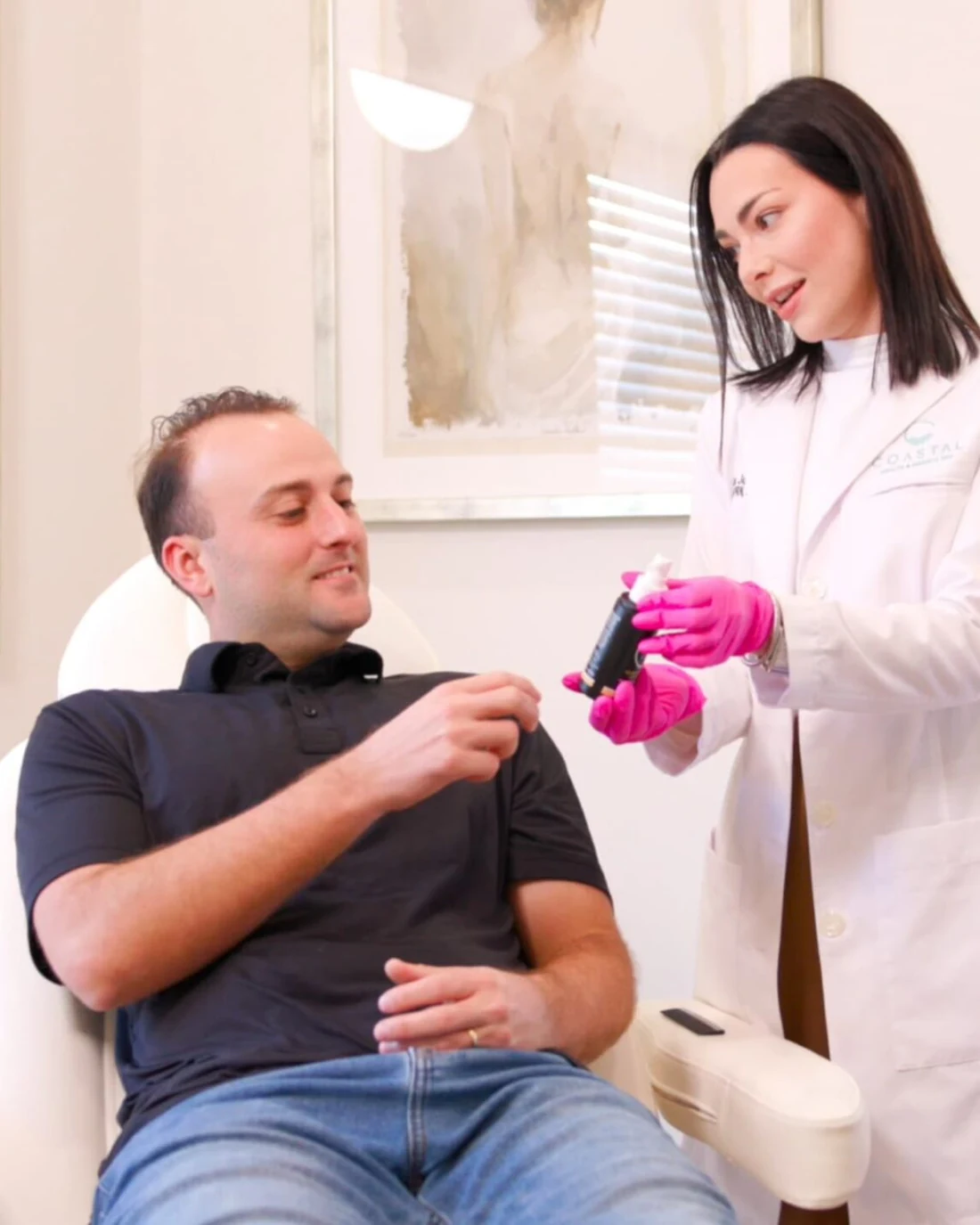
Dr. Olivia preparing a HydraFacial for a male patient. The same steps anchor Coastal’s men’s facial in Jacksonville.
What a HydraFacial Can’t Do
A HydraFacial does not remodel collagen the way microneedling, radiofrequency or laser treatments do. If your main concern is etched wrinkles, loose skin or acne scars, hydradermabrasion will make the surface look better for a week and leave the structure unchanged. Lines caused by muscle movement, like frown lines and crow’s feet, belong to neuromodulators, not facials. Our guide to HydraFacial vs microneedling walks through that decision.
Deep pigment is the other limit. Surface sun damage may look brighter after a series, but melasma sits deeper and can flare with any irritation, so it needs a provider-led plan rather than a facial. Any spot that is changing in size, shape or color needs prompt medical evaluation before any cosmetic treatment. If you’re unsure which category your concern falls into, a consultation sorts it out faster than trial and error.
Is a HydraFacial Worth It?
Worth it for what, exactly? For immediate radiant skin with no downtime, deep hydration and relief from mild congestion, a HydraFacial earns its reputation. It is the treatment to book before a photo, a wedding or a stretch of travel, and the one that keeps oily or congested skin calm between bigger procedures. For deep wrinkles, significant scarring or severe acne, it is the wrong tool, and no number of monthly treatments will change that.
The way to think about it: a HydraFacial maintains healthy skin and supports long-term skin health. It does not rebuild skin that needs structural work. Most people who are disappointed expected the second thing. Most people who love it wanted the first. Coastal lists the current tiers and add-ons on its HydraFacial page, so you can match the visit to your skin concerns before you book.
| Pros | Cons |
|---|---|
| Instant glow with no downtime | Results are temporary without regular treatments |
| Painless extractions that clear congestion | No collagen remodeling for deep wrinkles or scars |
| Works across skin types and tones, including sensitive skin | Evidence base is small and short-term |
| Customizable with boosters, LED and add-ons | Won’t resolve severe or cystic acne on its own |
| Pairs well with microneedling and peels on a provider-set plan | Not a substitute for a daily skincare routine and sun protection |
Signature, Deluxe, and Platinum: Which HydraFacial Tier Fits You
Coastal Health & Medical Spa offers three tiers of HydraFacial in Jacksonville. Every tier includes the four core steps. What changes is how much customization sits on top. The Signature is the four steps in about 30 minutes, and it is the right first visit for most people. The Deluxe adds a dermaplane, a custom mask, a booster serum chosen for specific skin concerns such as fine lines, pigmentation or firmness, and LED light therapy, in about 45 minutes. The Platinum is the longest and most complete visit: everything in the Deluxe plus a jelly mask with ice globes and a lymphatic drainage facial massage that reduces puffiness.
Two add-ons treat the areas the handpiece skips. The Eye Perk brightens and hydrates the under-eye area, and the Lip Perk exfoliates and plumps the lips; each comes with a take-home vial of the serum. The HydraPen pairs a HydraFacial with SkinPen microneedling in Jacksonville in one visit for people who want hydration and collagen stimulation together. Boosters come in three families: brightening with vitamin C and arbutin, calming with niacinamide and panthenol, and firming with peptides.

The Platinum tier adds the massage from Coastal’s lymphatic drainage facial.
| Tier | What’s Included | Best For |
|---|---|---|
| Signature | Cleanse, exfoliate, extract and hydrate; about 30 minutes | First visits, monthly maintenance, a quick glow before an event |
| Deluxe | Signature plus a dermaplane, a custom mask, a targeted booster serum and LED light therapy; about 45 minutes | Fine lines, early signs of aging, dullness or breakouts that need a specific booster |
| Platinum | Deluxe plus a jelly mask with ice globes and a lymphatic drainage massage; the longest, most complete visit | Puffiness, special occasions, or anyone who wants the full treatment |
How Long HydraFacial Results Last
Think of HydraFacial results in three layers. The glow is first: skin looks cleaner and more luminous right away, peaks at 24 to 48 hours once any pinkness fades, and holds about a week with a good skincare routine and daily SPF. Hydration is second: the nourishing serums leave the skin barrier better stocked for several days, so makeup sits better and tightness eases. Smoother texture and refined pores are third and last the longest, often a few weeks, because the extraction and exfoliation cleared what was sitting in the pores.
Then the skin does what skin does, and lifestyle habits like sun, sleep and skincare decide how fast. The outer layer renews itself on roughly a monthly cycle, so the dead skin cells, oil and congestion that were removed gradually rebuild. That cycle is the reason cadence matters more than any single visit. One HydraFacial treatment gives you a great week. Regular HydraFacial treatments keep the baseline higher, so each visit starts from cleaner, better-hydrated skin instead of resetting from scratch.
How Often Should You Get a HydraFacial?
Every 4 to 6 weeks is the standard answer, and for most people it’s the right one. That spacing lines up with the skin’s renewal cycle, so you’re clearing congestion and restocking hydration about as fast as they come back. The broader rules for how often to get a facial apply here too: skin type and goals set the rhythm, not the calendar. Oily skin and warm Florida months may pull you toward the four-week end; dry skin or sensitive skin that is already stable can stretch toward six.
Goals change the schedule. Acne or heavy congestion usually starts closer together on a short series your provider sets, then drops back to maintenance once the skin is clear. Before a wedding or big event, book 3 to 7 days out so the glow peaks on the day. If you’re pairing it with microneedling or a peel, your provider will space the two so the skin fully recovers between them.

Most people rebook every 4 to 6 weeks. Book your next HydraFacial with the Coastal team.
| Goal | Typical Spacing |
|---|---|
| Maintenance and glow | Every 4 to 6 weeks |
| Acne or congestion | Closer together at first on a provider-set plan, then back to maintenance |
| Before a wedding or event | 3 to 7 days before the date |
| Combined with microneedling or a peel | Spaced by your provider so the skin recovers between treatments |
Can You Get a HydraFacial Too Often?
Monthly treatments are the normal rhythm, and every month is not too often. More frequent treatments, closer than every two weeks, are where the benefit flattens out and the risk of irritation goes up, because you’re exfoliating skin that hasn’t finished renewing. That spacing only makes sense on a plan a skincare professional sets for a specific concern, usually acne, and only for a short stretch.
The signs you’ve overdone it are tightness that lasts past a day or two, new sensitivity to your usual products, or a flush that doesn’t settle. If that happens, give your skin a full cycle before the next visit and keep your skincare products gentle in between. More is not better here. Consistent is better.
HydraFacial Aftercare: The First 72 Hours
Good HydraFacial aftercare protects freshly treated skin and extends the glow. The post-treatment rules are simple and most of them run out within three days. For the rest of the day, leave your skin alone: don’t wear makeup, don’t touch it, don’t try new products. For 24 hours, avoid heat, so skip the sauna, hot yoga and hard workouts. For 48 to 72 hours, pause your actives and any harsh skincare products: retinoids, glycolic acid, salicylic acid, vitamin C and scrubs. Then for about a week, no waxing, chemical peels or laser on the treated skin.
Every day, including treatment day, use a gentle cleanser, a hydrating moisturizer and broad-spectrum SPF 30 or higher. The daily sunscreen guidance that applies to everyone applies twice over to skin that has just been exfoliated, and in Jacksonville that means sunscreen in November too. Direct or excessive sun exposure in the first few days is the fastest way to undo the hydration and even tone you just paid for, and fresh sun damage shows fastest on exfoliated skin.
| Timeframe | Do | Don’t |
|---|---|---|
| Rest of the day | Let the serums sit; drink water | Don’t wear makeup, touch your face or try new skincare products |
| First 24 hours | Gentle cleanser and moisturizer only | No sauna, hot yoga, hot showers on the face or hard workouts |
| 48 to 72 hours | Hydrating serum, moisturizer, SPF 30 or higher | No retinoids, AHAs, BHAs, vitamin C serums or scrubs |
| About one week | Ease back into your full skincare routine | No waxing, chemical peels, laser or direct sun exposure |
What to Put on Your Skin After a HydraFacial
Keep the post-treatment routine short for the first three days. A gentle, non-foaming cleanser in the morning and evening. A hyaluronic acid or ceramide moisturizer to keep skin hydrated and lock in the hydrating serums while the skin barrier settles. Broad-spectrum SPF 30 or higher every morning, reapplied if you’re outside. That’s the whole list, and it is enough.
If you added an Eye Perk or Lip Perk, use the take-home serum vial as directed; it is the same formula infused during treatment and it extends the benefit between visits. Hold the retinol and the exfoliating acids until day three or four, then reintroduce one at a time to prevent irritation. If your usual products are medical-grade, your provider can tell you which ones to restart first.
Side Effects and When to Call Your Provider
Mild post-treatment redness, warmth or a tight feeling for a few hours is normal, and for sensitive skin it can last up to 72 hours. Some people get a small crop of whiteheads in the week after treatment as loosened congestion works its way out; that usually clears on its own with gentle care. Slight dryness or flaking after a Deluxe or Platinum visit is also common because of the dermaplane and the peel step.
Call your provider if redness lasts more than a few days, if you notice swelling, hives or itching, or if a breakout is painful rather than superficial. Those reactions are rare, and most trace back to a booster ingredient or harsh skincare products restarted too soon. Tell your provider about any allergies, prescription skincare or recent treatments before the visit so the serums and suction level can be adjusted.
Who Should Wait on a HydraFacial
A HydraFacial treatment is gentle, but a few situations call for rescheduling. Wait if you have an active rash, sunburn or open breakouts on the face, because suction over broken skin spreads irritation. Wait if you have an active cold sore; exfoliation can spread it. If you’ve taken isotretinoin recently, hold off for the window your provider sets. And if you’ve had a chemical peel, laser or microneedling in the last week or two, let that skin finish healing before adding another procedure on top.
Rosacea and very reactive skin are not automatic no’s. Ask for lower suction, calming boosters and no dermaplane, and skip any zone that is flaring to prevent irritation. If you’re pregnant or nursing, ask your OB first and tell your provider so the serums are chosen accordingly. Our guide to facials during pregnancy covers what to skip. When in doubt, a short consultation with a skincare professional before booking is the fastest way to find out whether this is the right week.

Danielle Hancock, Licensed Aesthetician. Schedule a consultation to match a tier to your skin.
Your Next Step: Book a HydraFacial in Jacksonville
HydraFacials at Coastal Health & Medical Spa are performed by Danielle Hancock, Licensed Aesthetician, and Dr. Olivia, DNP, APRN, who match the tier, boosters and spacing to your skin rather than to a menu. Book your HydraFacial consultation to get a plan built around your skin type and goals. You can also read more about the Coastal team or reach our Jacksonville office with questions before your first visit.
Frequently Asked Questions
Is a HydraFacial worth the money?
For most people who want deep hydration, clearer pores and a noticeable glow with no downtime, yes. It is not worth it if your main goal is deep wrinkles, scarring or severe acne, because it does not remodel collagen. Match the tier to your skin concerns and book it when the glow matters most.
How long will HydraFacial results last?
HydraFacial results come in layers. The glow peaks 24 to 48 hours after treatment and holds about a week. Hydration lasts several days, and texture and pore refinement can last a few weeks. Results fade as the skin renews on its monthly cycle, which is why most people schedule regular treatments every 4 to 6 weeks.
What are the pros and cons of HydraFacial?
Pros: an immediate glow, painless extractions, smoother skin texture, no downtime, safe across skin types and tones, and customizable with boosters and LED. Cons: results are temporary, the evidence base is small, and it does nothing for deep wrinkles, scars or cystic acne. It is a maintenance treatment, not a corrective one.
Is it recommended to get a HydraFacial every month?
Yes. Monthly treatments line up with the skin’s renewal cycle, and regular HydraFacial treatments every 4 to 6 weeks are the standard maintenance schedule. Your provider may suggest closer spacing for a short stretch if you’re treating acne or congestion, then move you back to monthly once the skin is clear.
What should you not do after a HydraFacial?
HydraFacial aftercare is mostly about the first three days. Don’t wear makeup and keep your hands off your face for the rest of the day. Avoid saunas, hot yoga and hard workouts for 24 hours. Pause retinoids, exfoliating acids, vitamin C and scrubs for 48 to 72 hours. Avoid waxing, chemical peels, laser and direct sun exposure for about a week.
How soon after a HydraFacial can I wash my face?
Leave the serums on for the rest of the day, then wash that evening or the next morning with a gentle cleanser and lukewarm water. Skip anything with glycolic acid, salicylic acid or retinol for 48 to 72 hours. A soft cleanser and moisturizer are all post-treatment skin needs.
What is the best age for a HydraFacial?
There is no best age. People in their 20s use it for congestion and breakouts, those in their 30s to 60s for hydration, fine lines and uneven skin tone. The booster and tier change with your skin concerns, so your skin’s needs decide the plan, not your birthday.
Does a HydraFacial help with acne?
It can help mild to moderate acne. A small 2022 series of six clarifying treatments two weeks apart raised the share of adults rated clear or almost clear from 20 to 65 percent. It will not resolve severe or cystic acne alone and works best inside a plan your provider sets.
