CO2 laser recovery takes about 1 day of downtime after a Light PixelPeel and about 2 to 3 days after an Aggressive PixelPeel. Most patients flake or peel somewhere in days 2 to 4, look like themselves again within a week, and keep seeing collagen-driven improvement for 3 to 6 months after treatment.
The harder part is picturing it. Will you be red at Friday’s dinner? When does makeup go back on? Below is CO2 laser recovery day by day at Coastal Health & Medical Spa in Jacksonville, split by PixelPeel tier, so you can plan before you book.
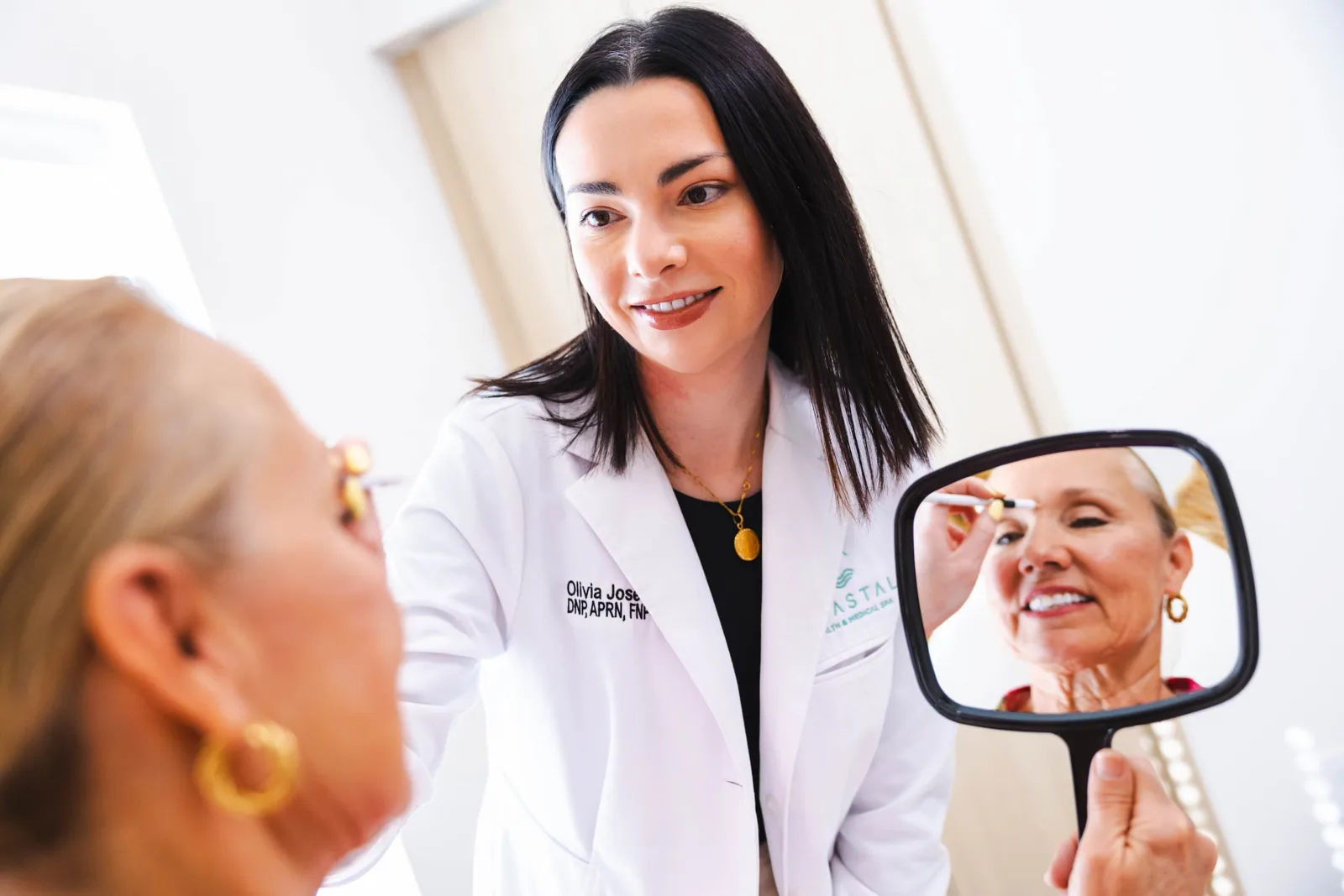
Dr. Olivia, DNP, APRN, walking a patient through her skin in the mirror at Coastal. See how PixelPeel CO2 laser resurfacing works.
Quick Answer: How Long CO2 Laser Recovery Takes
For most patients, a Light PixelPeel means one pink day, light flaking on days 2 to 3, and mineral makeup from day 5 to 7. An Aggressive PixelPeel means 2 to 3 days at home, peeling on days 2 to 4, and camera-comfortable skin by day 5 to 7. Leftover pinkness fades over weeks 2 to 4.
Key Points
- With CO2 laser resurfacing, the depth of the pass sets your timeline, and your tier is chosen at a free skin evaluation.
- The first 48 hours feel like a moderate sunburn: warm, tight and a little puffy.
- Keep healing skin moist and let flakes fall on their own; picking is the fastest way to a mark.
- No direct sun for at least 4 weeks, with mineral SPF 30 or higher every day.
- Retinoids and exfoliating acids wait 2 to 3 weeks; vitamin C serums wait 5 to 7 days.
- November through March is the easiest stretch of the year to heal from a laser in Jacksonville.
Why Your Recovery Depends on Treatment Depth
Fractional CO2 treats tiny columns of skin and leaves the surrounding tissue untouched, so new skin grows in from the edges. How deep those columns go sets your healing time. Healing after laser resurfacing runs anywhere from 3 to 10 days depending on depth and laser type, per this patient guide on laser resurfacing.
At Coastal Health & Medical Spa, CO2 laser resurfacing in Jacksonville is done on the Alma Hybrid, which pairs fractional CO2 with a 1570 nm non-ablative wavelength. PixelPeel is the CO2 protocol we run on it, two ways. Light PixelPeel is a shallower CO2 resurfacing pass for maintenance, early sun damage and mild texture. Aggressive PixelPeel goes deeper for fine lines, acne scarring, sun damage and rougher texture.
Dr. Olivia, DNP, APRN, recommends a tier at your free skin evaluation, based on your Fitzpatrick skin type, your concerns and how much downtime fits your schedule.
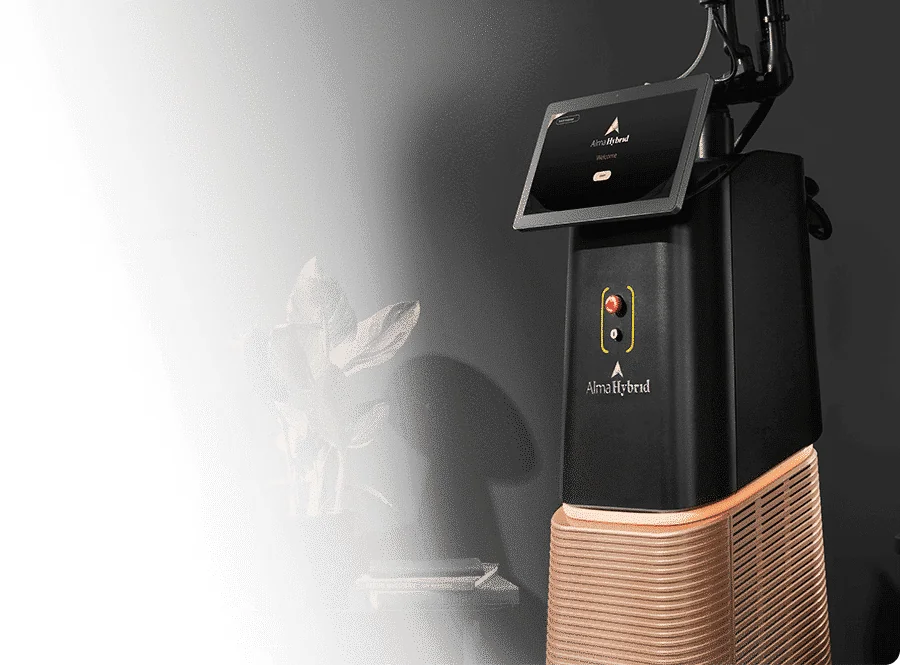
The Alma Hybrid runs both PixelPeel tiers; depth of the pass sets your recovery. Device imagery courtesy of Alma Lasers. Learn about the Alma Hybrid at Coastal.
| Tier | Downtime | What You See | Camera-Comfortable | Mineral Makeup | Best For |
|---|---|---|---|---|---|
| Light PixelPeel | About 1 day | Pink for a day, light flaking on days 2 to 3 | Day 1 to 3 for most | From day 5 to 7 | Maintenance, early sun damage, mild texture |
| Aggressive PixelPeel | About 2 to 3 days | Visible peeling on days 2 to 4, pinkness fading over weeks 2 to 4 | Day 5 to 7 for most | From day 7 to 10 | Fine lines, acne scarring, sun damage, rough texture |
CO2 Laser Recovery Day by Day
Here is what most Coastal patients see at each stage, tier by tier. Your written aftercare plan always has the final word.
Treatment Day: Warm, Pink, and Tight
Right after your CO2 laser treatment, your skin feels warm and looks pink to red, with a sunburn-like sensation. After a Light PixelPeel it’s closer to a mild sunburn; after an Aggressive one, a moderate sunburn. Before you leave, we apply a barrier-repair product and send you home with written post-care instructions built around your tier.
Plan to spend the evening at home. Cold compresses take the heat out, and a bland healing ointment keeps the surface moist. Sleep with your head elevated to keep swelling down. Some stinging or itching is expected for the first few days.
Light PixelPeel patients often feel close to normal by bedtime. Aggressive PixelPeel patients usually feel the warmth longer. Either way, the hard part isn’t the discomfort. It’s resisting the urge to check the mirror every 20 minutes.
Days 1 to 2: Redness and Swelling Peak
Redness, tightness and mild puffiness around the eyes and cheeks usually peak in this window. Patients describe it as wearing a mask that’s a size too small. That’s normal.
Wash with cool water, pat dry, and keep your skin moisturized with your barrier products whenever it feels tight. Keep sleeping elevated for the first two nights.
Moisture matters more than most people think. In a controlled study of moist wound care after fractional CO2, skin kept moist healed in about 5.7 days versus 7.7 days with dry care, and redness and swelling cleared sooner. Letting skin “breathe” is the old advice. Keeping it moist is the better one.
Light PixelPeel: most patients are pink for a day and back to normal activities by day 2. Aggressive PixelPeel: plan on staying home through day 2 or 3.
Days 2 to 5: Peeling and Renewal
This is the stage people dread, and it’s more manageable than it sounds. Treated skin starts to flake in small patches as new skin surfaces underneath, and it may feel rough and tight. This is a normal part of the healing process.
Light PixelPeel: most patients see light, fine flaking on days 2 to 3 that mineral makeup can cover from about day 5 to 7. Aggressive PixelPeel: visible peeling usually runs days 2 to 4, sometimes a little longer along the jawline.
Don’t pick, pull or scrub. The flakes lift on their own, and pulling them early can introduce bacteria or leave a raw patch or a dark mark. Clean hands help prevent infection. Keep everything moist, skip the washcloth, and avoid hot showers, saunas and hard workouts, which add redness your skin doesn’t need.
Itching is common here too. A cold compress helps more than scratching ever will.
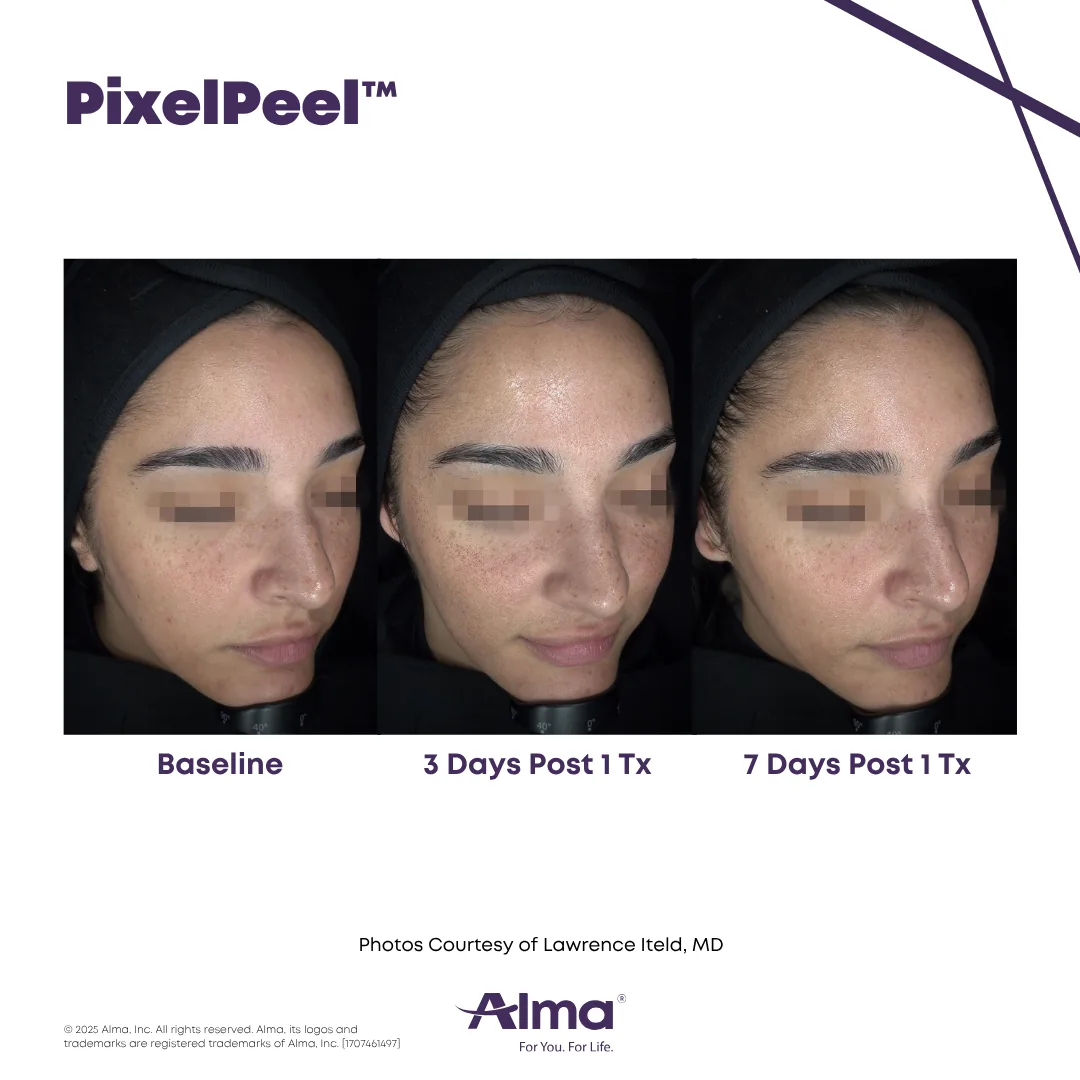
Baseline, day 3 and day 7 after one PixelPeel treatment. Photos courtesy of Lawrence Iteld, MD, via Alma Lasers (manufacturer example, not a Coastal patient; results vary). See more PixelPeel results.
Days 6 to 10: Back in Public
For Aggressive PixelPeel patients, this is the turn. Most feel camera-comfortable by day 5 to 7 and can apply makeup over leftover pinkness from day 7 to 10. Light PixelPeel patients are usually well past this point and back to normal activities.
Gentle skincare and light workouts can resume as your skin heals. Stick to a mild cleanser, a reparative moisturizer and mineral SPF, and keep strong actives on hold.
Your skin may look a little pink, especially after a warm shower, but it reads as fresh rather than “something happened.” Many patients find their skin already feels smoother. That’s the new skin. The deeper change comes later.
If something looks worse now than it did on day 3, call us. Healing should move in one direction.
Weeks 2 to 4: Pinkness Fades
Visible redness fades gradually through weeks 2 to 4, faster after a Light PixelPeel and slower after an Aggressive one. Some pinkness can linger for several weeks even after the surface has completely healed, mostly after heat or exercise, and makeup covers it easily.
This is when your routine starts to come back, in order. Vitamin C serums can usually return after the first 5 to 7 days. Retinoids and acids wait 2 to 3 weeks, or longer if your written plan says so. For the first 2 to 4 weeks, most patients use gentle cleansers and reparative moisturizers from our ZO Skin Health products, plus a mineral SPF.
Off-face areas run a little behind. The neck, chest and hands heal a day or two slower than the face because they have fewer oil glands and hair follicles to rebuild from.
Months 1 to 6: Collagen Keeps Working
After CO2 laser resurfacing, your surface heals in days. The rest takes months. Fractional CO2 heats columns of skin deep enough to trigger new collagen, and that collagen remodeling keeps going long after you look normal. A review of fractional lasers for photoaging describes how the laser stimulates collagen while sparing islands of untreated skin, which is why healing is faster than with older full-surface CO2.
Most patients see tone, texture and firmness keep improving for 3 to 6 months after their last treatment. Fine lines soften and sun-damaged skin looks less blotchy. The change is slow enough that you may not notice it day to day, but comparison photos show it.
Daily mineral sunscreen and a steady medical grade skincare routine are what keep those gains.
| Day Range | What You See | What to Do | Light PixelPeel | Aggressive PixelPeel |
|---|---|---|---|---|
| Treatment day | Warm, pink, tight skin | Barrier balm, cool compresses, sleep elevated | Pink and warm | Redder and warmer |
| Days 1 to 2 | Peak redness, mild swelling | Cool-water cleanse, keep skin moist | Pink for a day, then settling | Red and tight; stay home |
| Days 2 to 5 | Flaking and peeling | Don’t pick; no heat, sweat or actives | Light flaking days 2 to 3 | Visible peeling days 2 to 4 |
| Days 6 to 10 | Fresh, slightly pink skin | Gentle skincare, light workouts, mineral SPF | Back to routine; mineral makeup from day 5 to 7 | Camera-comfortable by day 5 to 7; makeup from day 7 to 10 |
| Weeks 2 to 4 | Pinkness fading | Bring actives back on schedule | Pinkness mostly gone | Pinkness fading |
| Months 1 to 6 | Gradual smoothing and firming | Daily mineral SPF | Results build, peaking at 3 to 6 months | Results build, peaking at 3 to 6 months |
Do’s and Don’ts After a CO2 Laser
Good post-procedure care is mostly restraint. Most recovery problems come from doing too much, not too little. Keep these two lists on your bathroom mirror for the first week.
Do:
- Keep treated skin moisturized with your barrier products
- Cleanse gently with cool water and pat dry
- Use cold compresses for heat and itching
- Sleep with your head raised the first two nights
- Wear broad-spectrum SPF 30 or higher in a mineral formula once your plan clears it, and stay in the shade
Don’t:
- Pick, peel or scrub flaking skin
- Use retinoids or exfoliating acids for 2 to 3 weeks, or vitamin C for 5 to 7 days
- Take hot showers, sit in a sauna or work out hard for 3 to 5 days
- Go into direct sun for at least 4 weeks
- Add new products mid-recovery without asking us first
When Can You Wash Your Face, Wear Makeup, and Work Out?
These three questions come up at nearly every follow-up. The answers depend on your tier, and your written aftercare plan has the final word.
Washing is the easy one. Most patients start washing with cool water within the first 24 hours, using clean fingertips and no washcloth. Makeup waits until peeling winds down, which is why the two tiers differ so much. Start with mineral formulas, skip heavy or long-wear products for the first two weeks, and remove makeup gently. Exercise is about heat and sweat. Both raise redness and can irritate skin that’s still rebuilding its barrier.
| Activity | Light PixelPeel | Aggressive PixelPeel | Why |
|---|---|---|---|
| Gentle cool-water cleansing | Within the first 24 hours | Within the first 24 hours | Keeps the surface clean without stripping the barrier |
| Mineral makeup | From day 5 to 7 | From day 7 to 10 | Skin needs to finish peeling first |
| Light workouts | Once flaking settles | Days 6 to 10 | Sweat and heat add redness |
| Intense workouts, hot showers, sauna | Skip for at least 3 to 5 days | Skip for at least 3 to 5 days, longer while peeling | Heat widens blood vessels and causes prolonged redness |
| Vitamin C serum | After 5 to 7 days | After 5 to 7 days | Acidic serums sting healing skin |
| Retinoids and exfoliating acids | After 2 to 3 weeks | After 2 to 3 weeks | Active ingredients on new skin raise irritation and pigment risk |
| Direct sun | Not for at least 4 weeks | Not for at least 4 weeks | UV on healing skin can trigger dark patches |
Sun Protection Is the Whole Game in Jacksonville
Post-inflammatory hyperpigmentation, the darkening that can follow irritation or injury, is the complication most worth preventing after CO2. Healing skin is primed to make extra pigment, and ultraviolet exposure is the trigger. In Jacksonville, that risk doesn’t take a season off.
The rule at Coastal is strict sun avoidance: no direct sun exposure for at least 4 weeks, and a broad-spectrum mineral sunscreen, SPF 30 or higher, for the whole healing window and for months after. Zinc oxide and titanium dioxide tend to be gentler on sensitive skin, and dermatology sunscreen guidance calls for broad-spectrum, water-resistant SPF 30 or higher, reapplied about every two hours outdoors. Add a hat and shade.
That’s also why November through March is laser season in Florida. The UV index runs lower, days are shorter, and it’s easier to stay out of the sun without canceling your life.
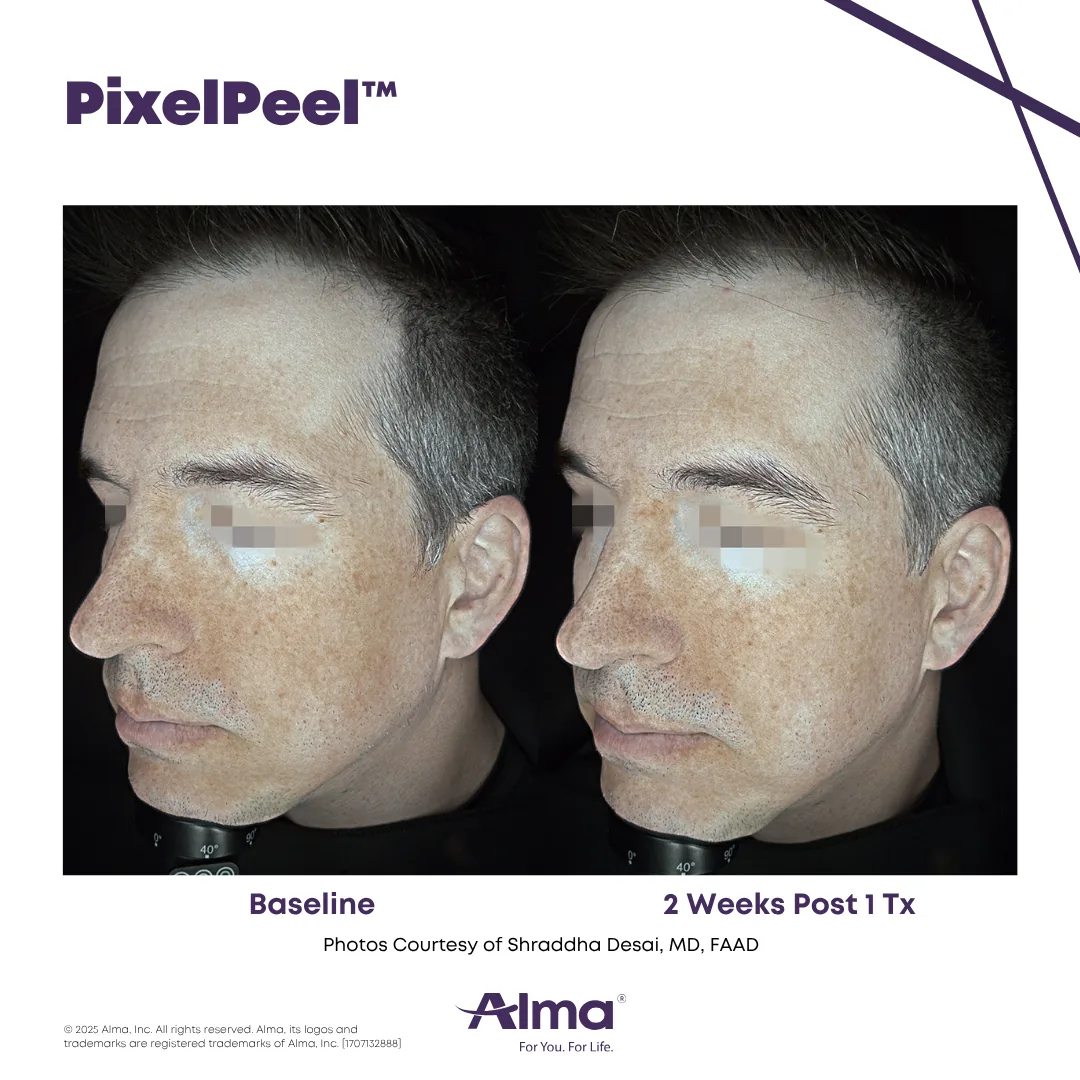
Sun-damage pigmentation at baseline and two weeks after one PixelPeel treatment. Photos courtesy of Shraddha Desai, MD, FAAD, via Alma Lasers (manufacturer example, not a Coastal patient; results vary). Learn about PixelPeel for sun damage.
Recovery on Medium and Deeper Skin Tones
Whatever your skin tone, the recovery steps are the same, but with more melanin the margin for error is smaller. Deeper skin tones are more likely to darken after laser injury. In a split-face study in skin of color treating acne scars, 30% of patients developed post-inflammatory hyperpigmentation on the fractional CO2 side versus about 7% on the microneedling side, and the risk climbed with higher Fitzpatrick types.
That’s why every new Coastal patient starts with a Fitzpatrick assessment. For medium and deeper tones, Dr. Olivia, DNP, APRN, decides case by case after the evaluation, whether that means conservative CO2 settings or the Alma Hybrid’s non-ablative 1570 nm arm on its own. Strict sun protection and gentle aftercare matter even more here.
If CO2 isn’t the right fit for your skin, you’ll hear that at the evaluation, along with a better option such as microneedling or a chemical peel.

Every CO2 plan at Coastal starts with a Fitzpatrick assessment. Book a free skin evaluation.
What Is Normal and When to Call Coastal
Most of what you see after a PixelPeel is normal: redness, swelling, warmth, itching, flaking, and tiny pinpoint marks in a grid where the laser touched down. This patient guide to resurfacing recovery notes that itching or stinging for a few days is expected and that redness fades gradually.
What isn’t normal is skin that gets worse instead of better. A review of fractional CO2 complications found that infection usually shows up several days after treatment as one area of delayed healing while the rest moves on. Following your plan keeps complication risk low. Call Coastal at (904) 257-3232 if you notice:
- Redness spreading beyond the treated area
- Pus, yellowish drainage, crusting or a foul smell
- Fever
- Blisters or a cold sore
- Pain that gets worse after day 3
- One area that looks worse than the rest
If you’ve had cold sores before, say so at your evaluation. Prescription prevention can be arranged ahead of treatment day.
Who Should Wait Before CO2 Laser
CO2 laser resurfacing isn’t the right call for everyone at every moment. Pre-treatment preparation starts at your evaluation, which covers skin history such as active acne, cold sores and rosacea, medications such as blood thinners and recent retinoid use, and pregnancy status before anything is scheduled. Postpone treatment if any of these apply:
- Isotretinoin use within the past 6 to 12 months
- Pregnancy or breastfeeding
- An active skin infection or cold sore on the treatment area
- A recent tan on the treatment area
- A personal history of keloid or hypertrophic scarring
How to Plan CO2 Laser Around Your Calendar
Treatment timing is simpler than it sounds: work backward from the date that matters. For a Light PixelPeel, book at least 3 to 5 days before an event. For an Aggressive PixelPeel, give yourself 10 to 14 days so peeling is done and any pinkness is easy to cover.
Holidays are the easy target. A session in the first half of November puts most patients back in public well before Thanksgiving, with plenty of healing time before December photos. If your laser treatment includes the neck or chest, add a day or two, since off-face skin heals a little slower.
A Thursday or Friday appointment lets most of the downtime land on the weekend. If your calendar is packed through the holidays, start with a Light PixelPeel and save Aggressive for January or February, while the UV index is still low.
CO2 Laser Recovery vs Microneedling and Chemical Peels
If the downtime sounds like more than you want right now, there are lighter options. Here is how recovery compares across the resurfacing treatments Coastal offers. For the full side-by-side on results and skin types, see our guide to microneedling vs laser.
| Treatment | Typical Downtime | Peeling | Best For |
|---|---|---|---|
| SkinPen microneedling in Jacksonville | Pink for about a day; no social downtime for most | None to minimal | Fine lines, acne scars, pores, texture; all Fitzpatrick types |
| ZO Stimulator Peel | None | None to light | Dull skin, dark spots, maintenance |
| Perfect Derma Peel | About a week | Visible peeling, about days 3 to 7 | Pigment, uneven tone |
| Light PixelPeel | About 1 day | Light flaking days 2 to 3 | Maintenance, early sun damage, mild texture |
| Aggressive PixelPeel | About 2 to 3 days | Peeling days 2 to 4 | Fine lines, acne scarring, sun damage, rough texture |
CO2 reaches deeper and builds more collagen per treatment, but it asks for more aftercare discipline. SkinPen and peels fit better when you can’t take any downtime or when pigment risk is high.
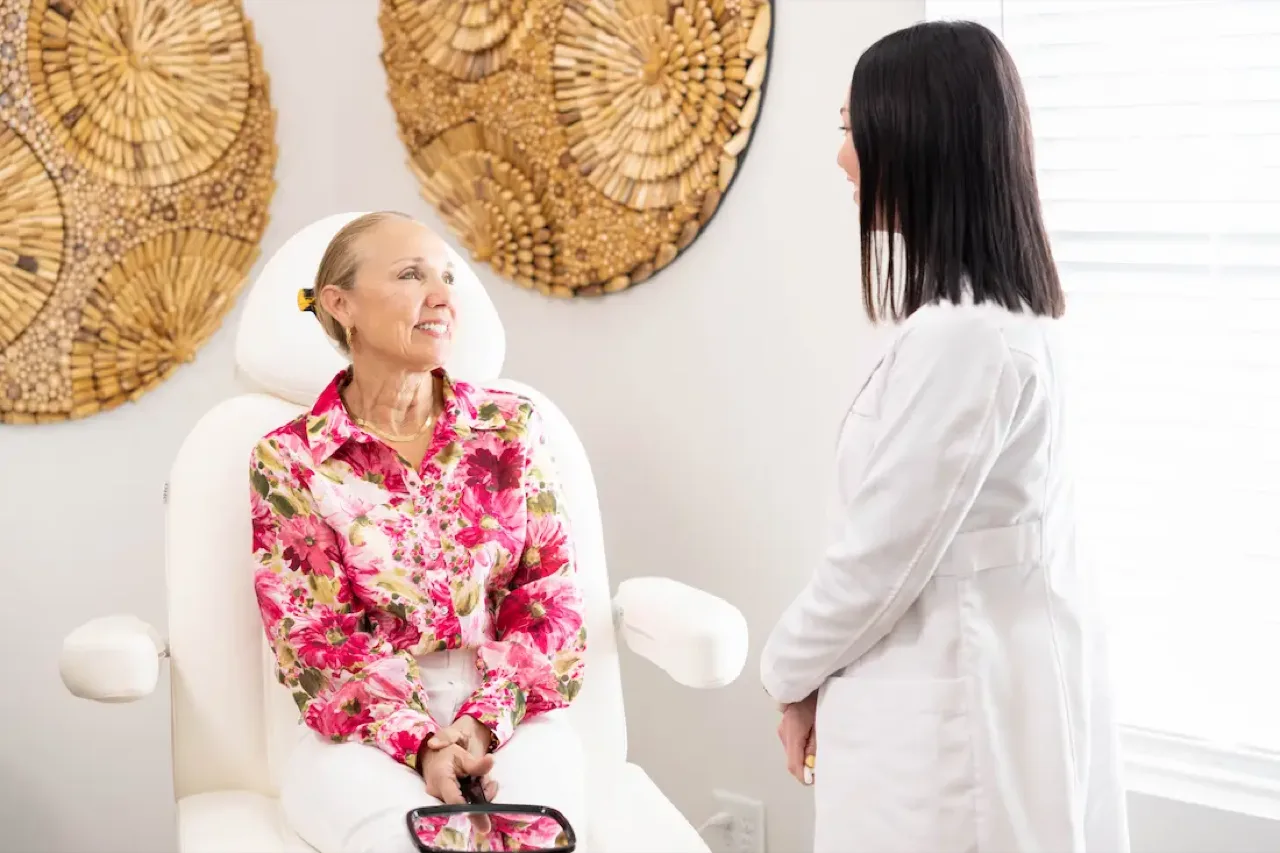
The consult room at Coastal, where your PixelPeel tier and aftercare plan are set. Schedule a consultation.
Your Next Step: Book a Free Skin Evaluation
The best recovery plan starts before the laser ever touches your skin. At a free skin evaluation, Dr. Olivia, DNP, APRN, checks your Fitzpatrick type, matches you to Light or Aggressive PixelPeel, and builds a written aftercare plan around your calendar. Book a free skin evaluation at Coastal Health & Medical Spa in Jacksonville, and you’ll know what each day of recovery should look like before it starts.
Frequently Asked Questions
Do and don’ts after CO2 laser?
Do keep the skin moist with your barrier products, cleanse gently with cool water, use cool compresses, sleep elevated for two nights and wear mineral SPF 30 or higher. Don’t pick or scrub flaking skin, use retinoids or acids for 2 to 3 weeks or vitamin C for 5 to 7 days, take hot showers or work out hard for 3 to 5 days, or go into direct sun for at least 4 weeks.
How long after a CO2 laser do you look good?
Most patients look like themselves again within 1 to 3 days after a Light PixelPeel and by day 5 to 7 after an Aggressive PixelPeel. Leftover pinkness fades over weeks 2 to 4 and covers easily with makeup. The best results come later, as collagen rebuilds over 3 to 6 months after your last treatment.
How soon can you wash your face after a CO2 laser?
Most patients start gentle cleansing within the first 24 hours, following their written aftercare plan. Use cool water, a mild cleanser and clean fingertips, then pat dry with a soft cloth and reapply your barrier products right away. Skip washcloths, scrubs, cleansing brushes and hot water until peeling is finished, because friction and heat irritate healing skin.
How many days after a CO2 laser can I wear make-up?
After a Light PixelPeel, most patients can wear mineral makeup from day 5 to 7. After an Aggressive PixelPeel, most wait until day 7 to 10, once peeling has finished. Start with mineral formulas, apply with clean tools, avoid heavy or long-wear products for the first two weeks and remove makeup gently each night.
Can I exercise after a CO2 laser?
Yes, but not right away. Skip hard workouts, hot yoga and saunas for at least 3 to 5 days, and longer while you’re still peeling, because heat and sweat cause increased redness and irritation. Walking is fine early on. Most patients return to light workouts once flaking settles after a Light PixelPeel, or around days 6 to 10 after an Aggressive one.
How long after a CO2 laser can I go in the sun?
Avoid direct sun for at least 4 weeks after a CO2 laser, even on cloudy Jacksonville days. When you do go out, wear broad-spectrum SPF 30 or higher, reapply about every two hours and add a wide-brimmed hat. Keep up diligent sun protection for months afterward, because sun exposure on newly healed skin can trigger dark patches.
